Starting Solids at 6 Months: A Complete Guide for Indian Parents
When to start, what to give first, how much and how thick. What the WHO and Government of India guidelines say about your baby’s first food, in plain words and pictures, with page numbers you can check.
The short answer
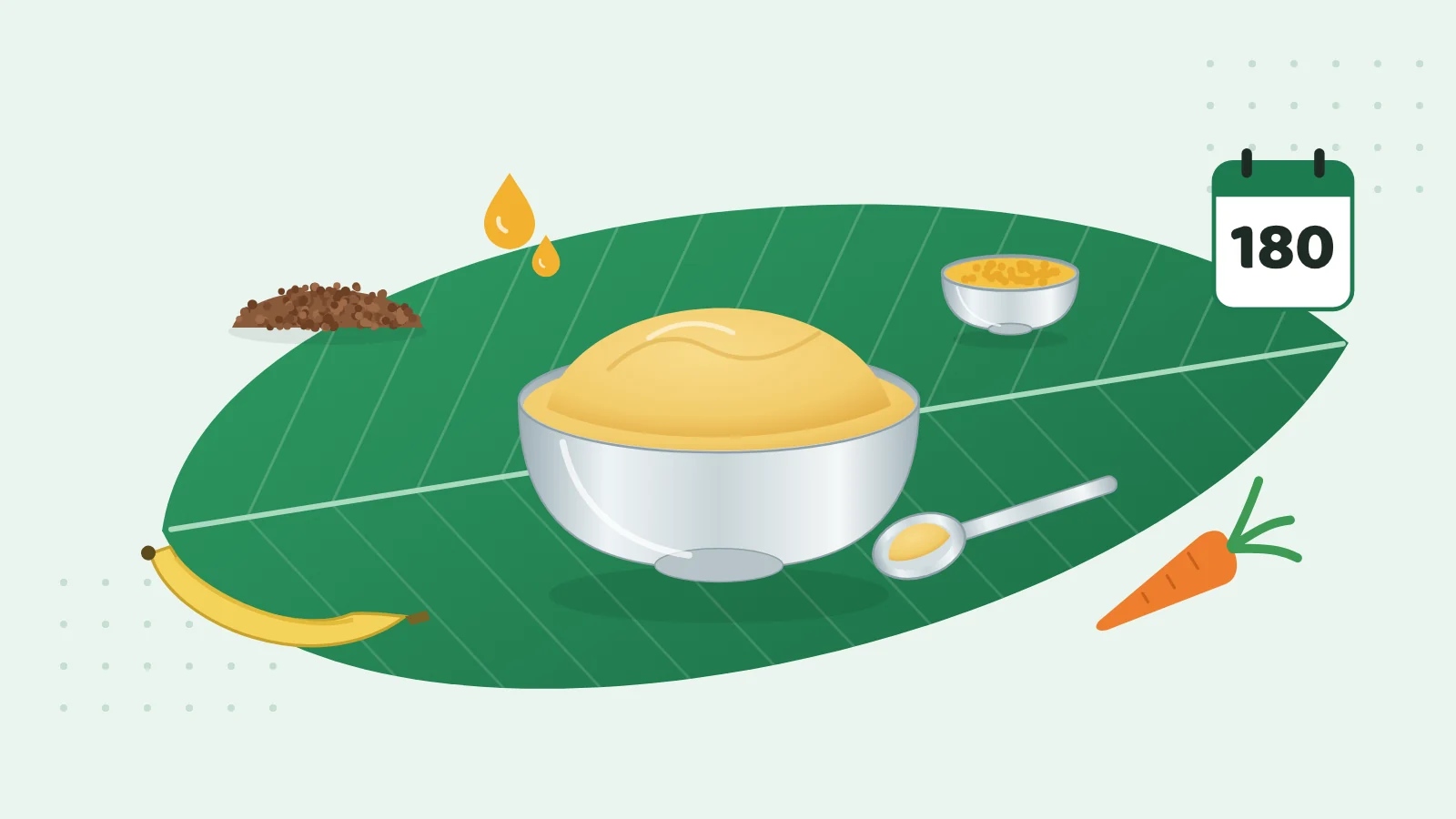
Start your baby’s first food when they complete 6 months, which is 180 days after birth, and keep breastfeeding alongside. WHO, India’s IYCF guide and India’s 2024 Dietary Guidelines all agree. Begin with 2–3 spoonfuls of soft, mashed home food twice a day, and build up slowly over the next weeks.
When does my baby complete 180 days?
Pick the date of birth to see the day your baby completes 180 days.
5 things to remember
When should my baby start solid food?
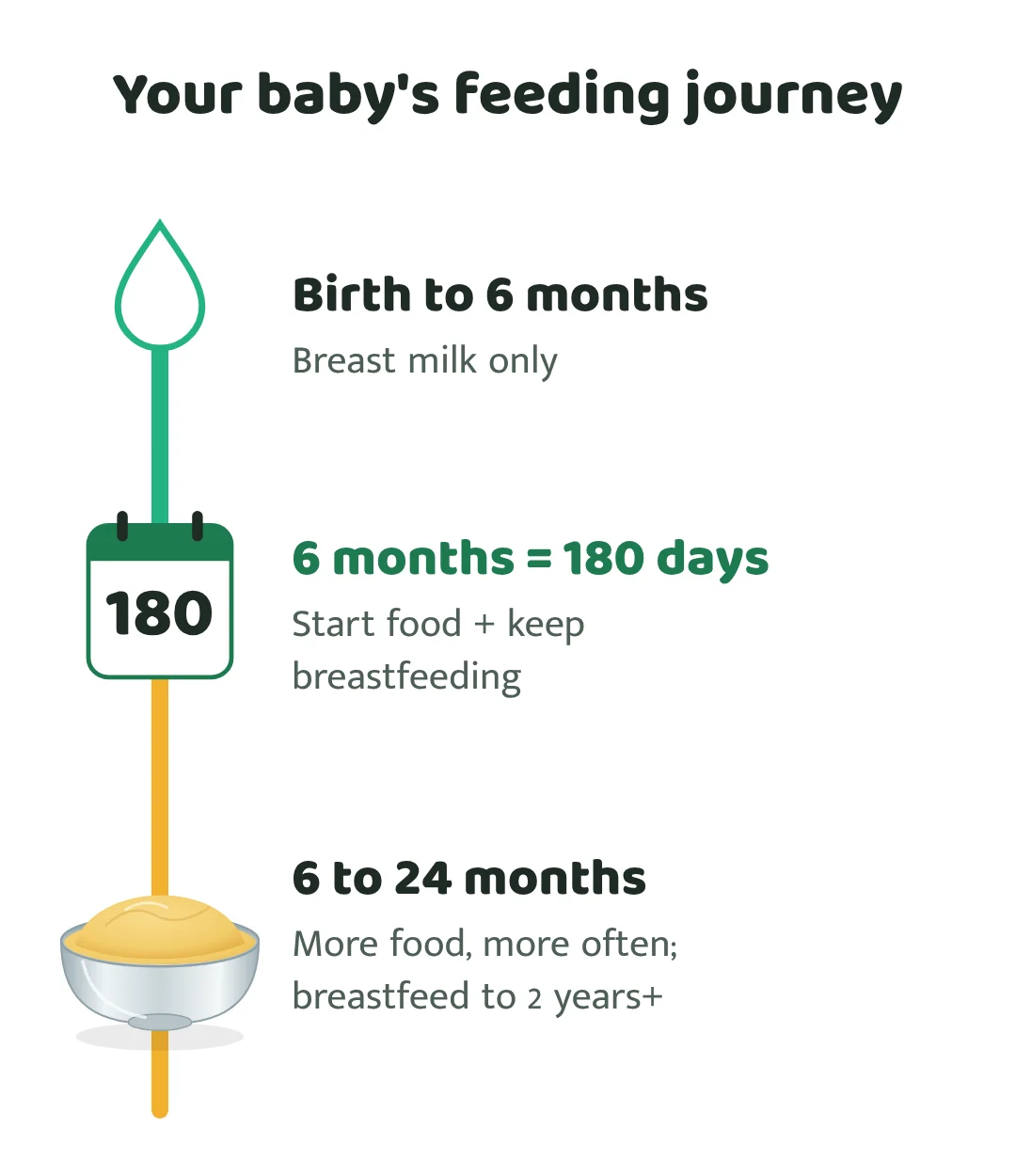
At 6 months. WHO defines this as 180 days after birth, and India’s IYCF guide uses the same number. India’s 2024 Dietary Guidelines say the same: breast milk alone for the first 6 months, then food alongside it. WHO 2023, Rec. 3, p.20 MoHFW, p.140 NIN 2024, p.26
Until then, breast milk alone gives your baby everything they need. After 6 months it is still important, but no longer enough on its own. The extra food your baby needs from this age is called complementary food: food that adds to breast milk, not food that replaces it. MoHFW, p.140
Why the books take this so seriously: the Government of India’s guide calls the first two years a critical window for a child’s growth, and notes that undernutrition in Indian children starts early and is at its worst around 2 years of age. MoHFW, Preface
babies under 6 months in South Asia are already being given food, WHO reports. If relatives are telling you to start early, you are far from the only mother hearing it. WHO 2023, p.20–21
Signs your baby is getting ready
The calendar comes first: 6 months. Around that age, most babies also start to show these changes. MoHFW, p.140
- Sits uprightWHO calls sitting without support an important sign, because it goes together with the gut, kidneys and immunity maturing. WHO, p.20
- Watches you eatTakes an interest in food when the family is eating.
- Puts things in the mouthBrings hands and toys to the mouth and munches on them.
- Better tongue controlMoves things around inside the mouth with more control.
- First teethTeeth often start coming in around this age.
These signs on their own are not a reason to start before 6 months. Reaching for food and teething are exactly the reasons families most often start too early. MoHFW, p.140–141
“But my baby seems hungry at 4 or 5 months”
This is the most common worry. Families often start early because the baby reaches for food, starts teething, seems hungry or isn’t gaining weight. Baby food advertisements play a part too, and so does a mother going back to work. MoHFW, p.140–141
The IYCF guide’s answer is clear: most babies do not need any food before 6 months. If your baby seems hungry after feeds or isn’t gaining weight well, the first step is help with breastfeeding, so that it works better for both of you. MoHFW, p.141
WHO adds that mothers who worry about their milk supply can benefit from breastfeeding (lactation) support. And because 6 months is a public health recommendation, a few individual babies may benefit from starting earlier. That is a decision for your baby’s doctor, not for well-meaning relatives. WHO 2023, p.20
Too early or too late: why timing matters
This isn’t about blame. It simply explains why the books settled on 6 months.
Starting before 6 months can
- take the place of breast milk, so your baby drinks less of it
- mean thin, low-nutrient food, because watery porridge is easy to feed
- reduce the protection breast milk gives, so illness becomes more likely
- raise the chance of diarrhoea, because other food is not as clean as breast milk
- increase the risk of wheezing and breathing allergies
Starting well after 6 months can
- leave your baby short of the extra food they need to grow
- slow down growth and development
- raise the risk of malnutrition and anaemia (low iron)
- make illness more likely
- make it harder to accept new tastes and textures WHO, p.20
Already started a little early? Please don’t feel guilty. Keep breastfeeding often, keep the food clean and thick, and mention it to your doctor at the next check-up.
Keep breastfeeding: food is added, not swapped
Starting food doesn’t mean stopping breast milk. WHO recommends breastfeeding up to 2 years or beyond, and India’s 2024 guidelines say the same. The IYCF guide’s very first key message: breastfeeding for at least two years helps a child grow strong and healthy. WHO 2023, Rec. 1, p.11 MoHFW, p.167 NIN 2024, p.22
At 6 months, food is given twice a day plus frequent breastfeeds. Breastfeeds stay in every row of the IYCF feeding table, right up to 2 years. MoHFW, p.151
What to give first: fill your baby’s bowl
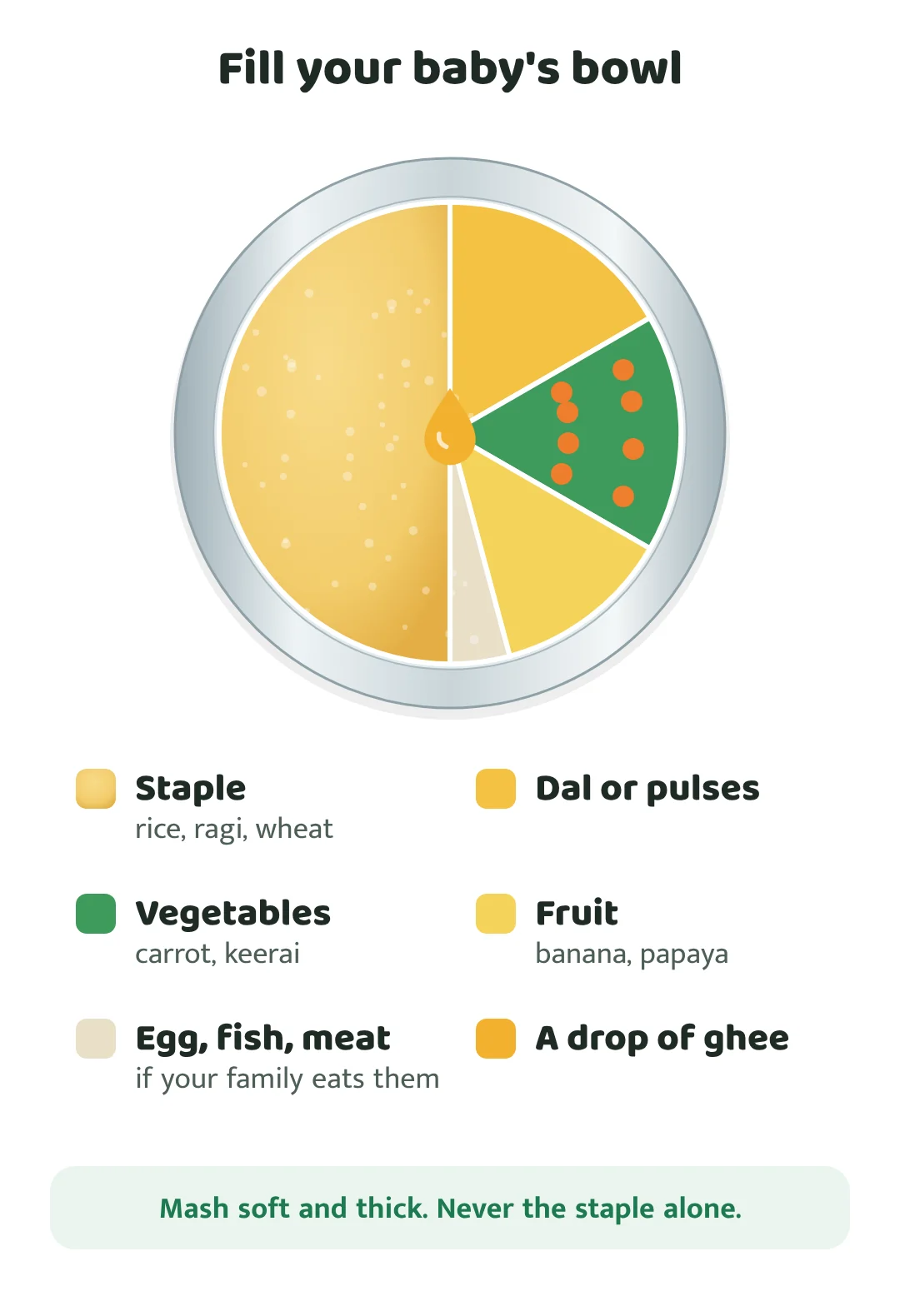
The IYCF guide asks you to picture your baby’s own bowl. What can your family put in it to help your baby grow well? MoHFW, p.142
Start with your family’s staple…
Rice, wheat and millets (ragi is a millet), starchy roots like potato, and starchy fruits like banana. MoHFW, p.142
…but never the staple alone
Staples give energy, but they can’t provide all the nutrients a baby needs. MoHFW, p.143 WHO adds: keep starchy staples to a minimum, and choose whole grains over refined ones. WHO 2023, Rec. 4, p.24
Add these every day if you can
- Dal and other pulses. Good sources of nutrients. For vegetarian families, WHO says pulses, nuts and seeds should be eaten often. MoHFW, p.147 WHO, p.24
- Vegetables and fruits, daily. Especially vitamin A foods like carrot, pumpkin, papaya, mango, yellow sweet potato and dark green keerai. WHO, p.24 MoHFW, p.148
- Egg, fish, chicken or liver, if your family eats them. Cook well, then mash or mince finely. WHO and the IYCF guide include these from 6 months; India’s 2024 guidelines suggest small amounts from 8 months. If you’re unsure, ask your doctor. WHO, p.24 MoHFW, p.146 NIN 2024, p.27
- Milk, curd and a little ghee. A teaspoon of ghee or oil adds energy in a small amount and makes thick food softer to eat. MoHFW, p.145–146
Iron tip: serve iron foods like dal, keerai, egg or meat with vitamin C foods like tomato, guava, papaya or orange. Vitamin C helps the body absorb iron. Tea and coffee do the opposite, so keep them away from baby’s meals. MoHFW, p.147, p.149
| Home food | How to make it baby-ready |
|---|---|
| Soft rice + paruppu + a drop of ghee | Cook very soft, then mash together until smooth. |
| Ragi porridge | Make it thick, not a drinkable koozh. Roasting the grain before grinding means less water and more nutrition per spoon. MoHFW, p.145 |
| Ripe banana | Mash smooth with the back of a spoon. |
| Sakkaravalli kizhangu or potato | Steam or boil until soft, then mash. |
| Carrot, pumpkin, keerai | Cook soft and mash into the rice and dal. |
| Sambar or dal from the family pot | Lift out the dal and vegetable pieces and mash them, not just the watery part. MoHFW, p.145 |
| Groundnut or sesame | Only as a smooth paste stirred into food, never whole: whole nuts and seeds can cause choking. MoHFW, p.145 WHO, p.24 |

How much and how often
Your baby is learning a brand-new skill, so start small: 2–3 spoonfuls, twice a day, then build up slowly over the weeks. MoHFW, p.151
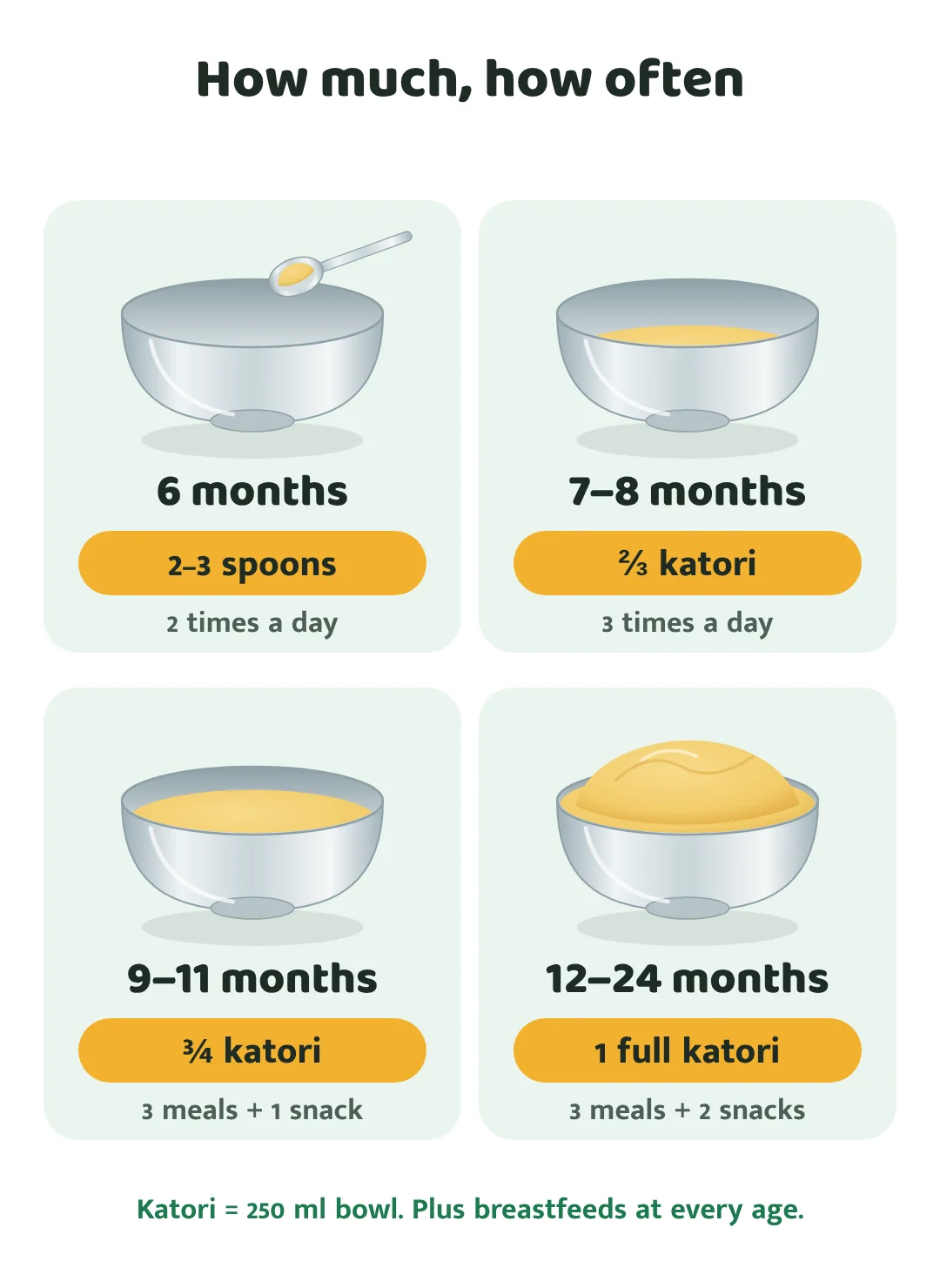
| Age | Texture | How often | Amount each time |
|---|---|---|---|
| 6 months | Soft porridge, well-mashed vegetables, fruit or meat | 2 times a day + frequent breastfeeds | 2–3 tablespoons |
| 7–8 months | Mashed food | 3 times a day + frequent breastfeeds | Slowly up to ⅔ of a 250 ml katori |
| 9–11 months | Finely chopped or mashed, plus food baby can pick up | 3 meals + 1 snack + breastfeeds | ¾ of a 250 ml katori |
| 12–24 months | Family food, chopped or mashed if needed | 3 meals + 2 snacks + breastfeeds | A full 250 ml katori or more |
MoHFW, p.151
“Snacks” here means nutritious extra food between meals, like fruit or curd. Not sweets, sweet biscuits or chips. MoHFW, p.150 Treat the amounts as a guide, not a target: offer, encourage gently, and let your baby decide when they’ve had enough. MoHFW, p.152
The spoon test: thick, not watery
Watery food feels safer and quicker to feed, but a baby’s stomach is small: at 8 months it holds only about 200 ml at a time. Fill it with watery porridge and it’s full before your baby gets enough energy. MoHFW, p.143–144
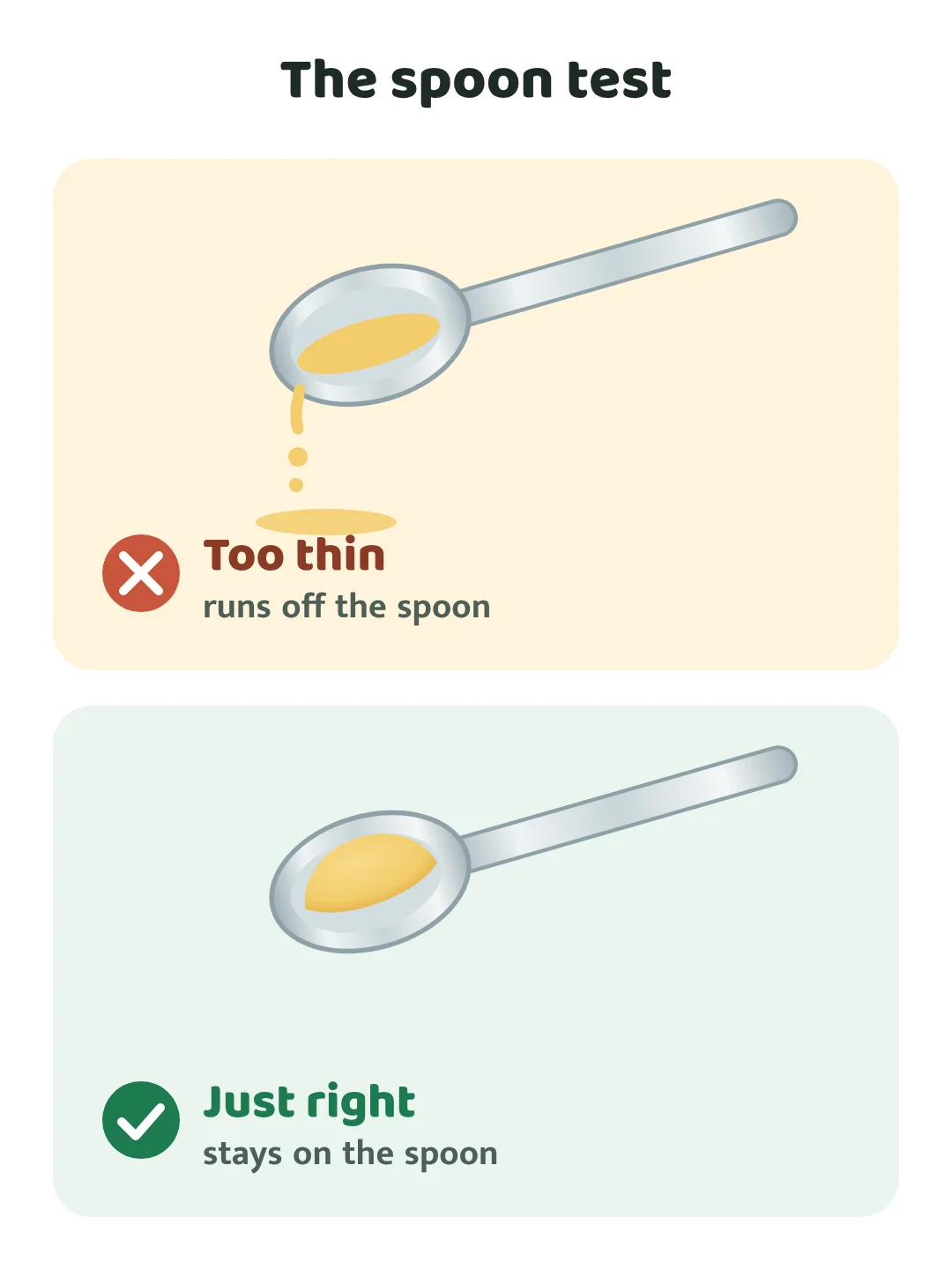
How to test: scoop some food and tilt the spoon. It should stay on the spoon and not run off. Food thin enough to go through a bottle, or for a child to drink from a cup, is too thin to give enough energy. MoHFW, p.144
The first 4–5 days: India’s 2024 Dietary Guidelines suggest starting with a thin but not watery porridge, such as dal gruel, for the first 4–5 days, then making it gradually thicker. After that first week, use the spoon test every time. NIN 2024, p.27
Worried thick food will stick in the throat? Many families are, and that’s why they add extra water. The IYCF guide reassures parents that babies can eat thick foods without problems. MoHFW, p.143, p.146
How to feed: patient, responsive and clean
WHO recommends responsive feeding: following your baby’s signals so they learn to eat. Showing mothers how to feed matters as much as what to feed, says the IYCF guide. WHO 2023, Rec. 7, p.43 MoHFW, p.161
- Wash your hands and your baby’s hands before every meal. MoHFW, p.159
- Sit facing your baby at their eye level. Smile and talk while you feed. p.159, p.161
- Use your baby’s own small bowl and spoon, so you can see how much they ate. p.160
- Feed slowly. When your baby stops, wait a moment, then offer a little more. p.161
- Read the signals. Reaching for food or crying can mean hungry; turning away, shutting the mouth or spitting out can mean full. p.159
- Never force food or scold your baby for not eating. p.161
- Feed when your baby is awake and happy, not sleepy or very upset. p.160
- Use a cup and spoon, not a feeding bottle. Cups are easier to keep clean. p.184
- For drinking water: boil, cool, and keep covered. p.149

What to leave out
The WHO 2023 guideline is direct about this, and India’s 2024 guidelines agree. WHO 2023, Rec. 5, p.32 NIN 2024, p.27
- No added sugar or salt. India’s 2024 guidelines say added sugar must be avoided completely before age 2. NIN 2024, p.27, p.29
- No foods high in sugar, salt or trans fats, like sweets, chips and many packaged snacks.
- No sugar-sweetened drinks or fizzy drinks. MoHFW, p.149
- No artificial (non-sugar) sweeteners.
- Limit fruit juice. Whole, mashed fruit is the better choice. WHO, p.32 NIN 2024, p.27
- No tea or coffee with meals, because they reduce iron absorption. MoHFW, p.147, p.149
Where the books differ: the 2016 MoHFW guide says a little sugar or jaggery can add energy. The newer WHO 2023 and ICMR-NIN 2024 guidelines both say no added sugar for children under 2. We follow the newer guidance. MoHFW, p.145 WHO, p.32 NIN 2024, p.29
Your first-day plan
- Check the date: your baby has completed 180 days.
- Choose a time when your baby is awake and happy.
- Wash your hands and your baby’s hands.
- Make a small amount of soft food, like well-cooked rice and dal mashed with a drop of ghee. For the first 4–5 days it can be a little thinner (but not watery).
- Sit your baby upright, facing you.
- Offer a little on the tip of the spoon and let your baby open their mouth for it.
- Stop when your baby turns away. Praise them, and breastfeed as usual.
- Repeat twice a day. Thicken the food and slowly increase the amount over the coming weeks.
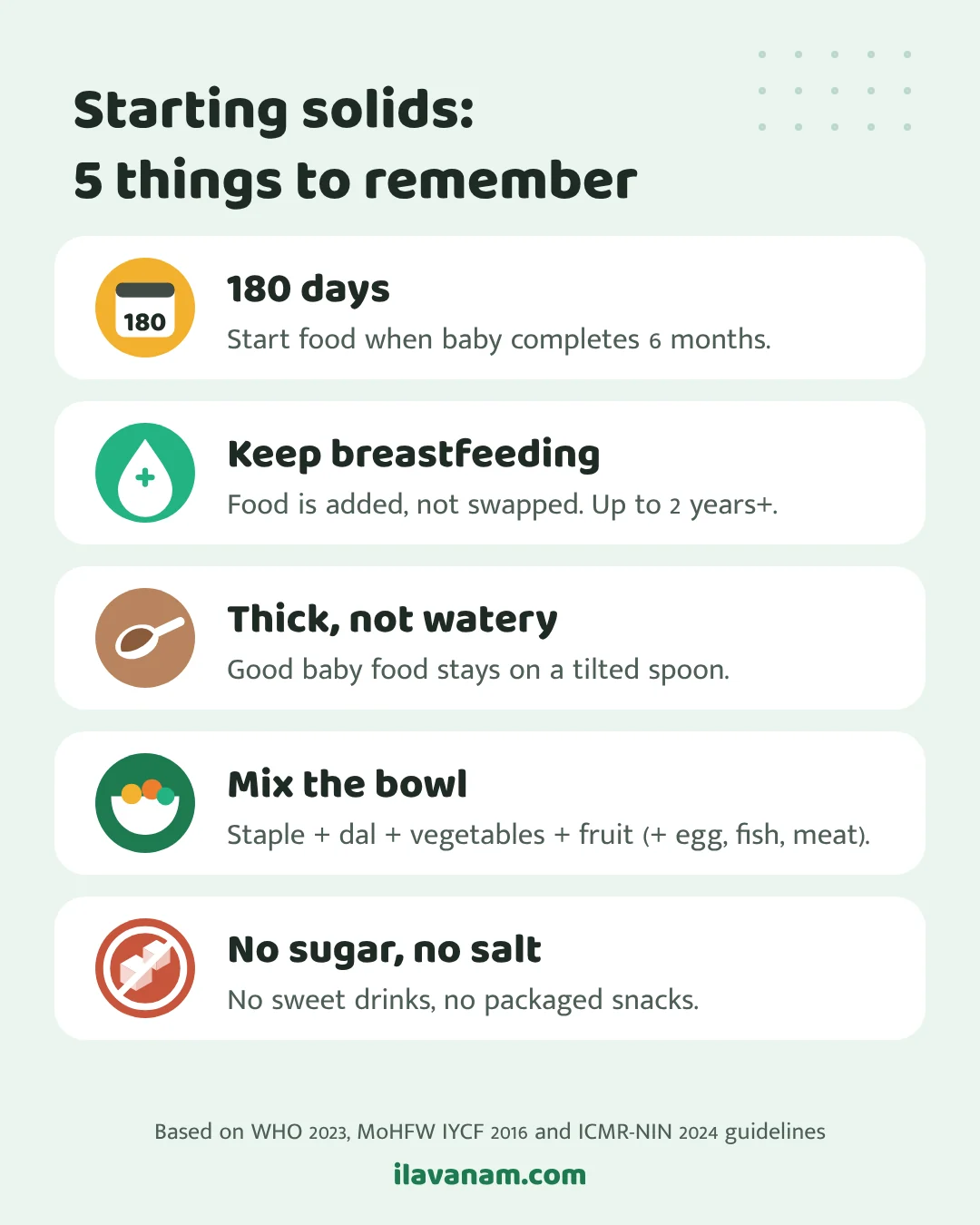
Save this for later
The 5 things to remember, on one picture. Save it to your phone or share it with your family.
Download the pictureQuestions moms often ask
Is “6 months” counted from my baby’s date of birth?
Yes. WHO defines it as 180 days after birth, and the IYCF guide uses the same number. Use the calculator at the top of this page to find your baby’s date. WHO, p.20 MoHFW, p.140
My baby is 5 months old and seems hungry. Can I start food now?
Most babies don’t need food before 6 months. If your baby seems hungry or isn’t gaining weight, help to make breastfeeding work better is usually the first step. A few babies may benefit from starting earlier, but that’s your doctor’s decision. MoHFW, p.141 WHO, p.20
Should I reduce breastfeeding once my baby starts food?
No. Food is added alongside breastfeeding, and breastfeeds stay frequent, up to 2 years or beyond. WHO, p.11 MoHFW, p.151
Should the first food be thin or thick?
India’s 2024 guidelines suggest a thin but not watery porridge for the first 4–5 days, then gradually thicker. After that, food should be thick enough to stay on a tilted spoon. NIN 2024, p.27 MoHFW, p.144
When can my baby have egg, fish or meat?
WHO and the 2016 IYCF guide include well-cooked, mashed animal foods from 6 months. India’s 2024 Dietary Guidelines suggest small amounts of thoroughly cooked egg, fish and meat from 8 months. If you’re unsure, ask your doctor. WHO, p.24 MoHFW, p.146 NIN 2024, p.27
Can I give my baby water after 6 months?
Once other foods start, your baby may need some extra fluids. Frequent, pale urine usually means enough; scanty or dark urine means more is needed. Give boiled, cooled water kept covered, and boil it again if not used within 24 hours. MoHFW, p.149
Can I add a little salt or sugar so the food tastes better?
No. WHO 2023 says foods high in sugar and salt should not be given to children aged 6 to 23 months, and India’s 2024 guidelines say added sugar must be avoided completely before age 2. Plain home food is new and interesting enough for your baby. WHO, p.32 NIN 2024, p.27, p.29
What is the best first food: rice, ragi or fruit?
There’s no single magic first food. Start with your family’s soft staple, then quickly add dal, vegetables and fruit. Variety matters more than which food comes first. WHO, Rec. 4, p.24 MoHFW, p.142–147
My baby keeps spitting the food out. Is something wrong?
Usually not. New tastes and textures take time. Don’t force; offer again a little later, and keep mealtimes calm. MoHFW, p.151, p.161
My baby was born early or with low birth weight. Does this guide apply?
Not fully. The WHO guideline is written for babies born at full term. Please ask your doctor when and how your baby should start food. WHO 2023, p.2
Sources: check every fact yourself
Every fact here comes from three public health books. We give the page number so you can check any line.
- World Health Organization. WHO Guideline for complementary feeding of infants and young children 6–23 months of age. 2023. Scope (p.2), Rec. 1 (p.11), Rec. 3 (p.20–21), Rec. 4 (p.24), Rec. 5 (p.32), Rec. 7 (p.43).
- Ministry of Health and Family Welfare, Government of India. Infant and Young Child Feeding: Trainers’ Guide (MAA programme). August 2016. Preface; Session 13 (p.139–152); p.159–161; p.167; p.184.
- ICMR-National Institute of Nutrition. Dietary Guidelines for Indians. 2024. Guideline 3 (p.21–25), Guideline 4 (p.26–31).
You can read all three free from our infant feeding guidelines page.
Please note: this guide shares public health guidelines for awareness only. We are not doctors. Every baby is different, so please talk to your doctor before making changes to your baby’s food, especially if your baby was born early, has a health condition, or isn’t growing well.
How we made this guide: every fact comes from the public health books above and was checked against the page we cite. There are no product links on this page.
Watch the Mom to Mom series
Short Tamil videos on baby feeding, explained from these same guideline books.
Follow us on Instagram